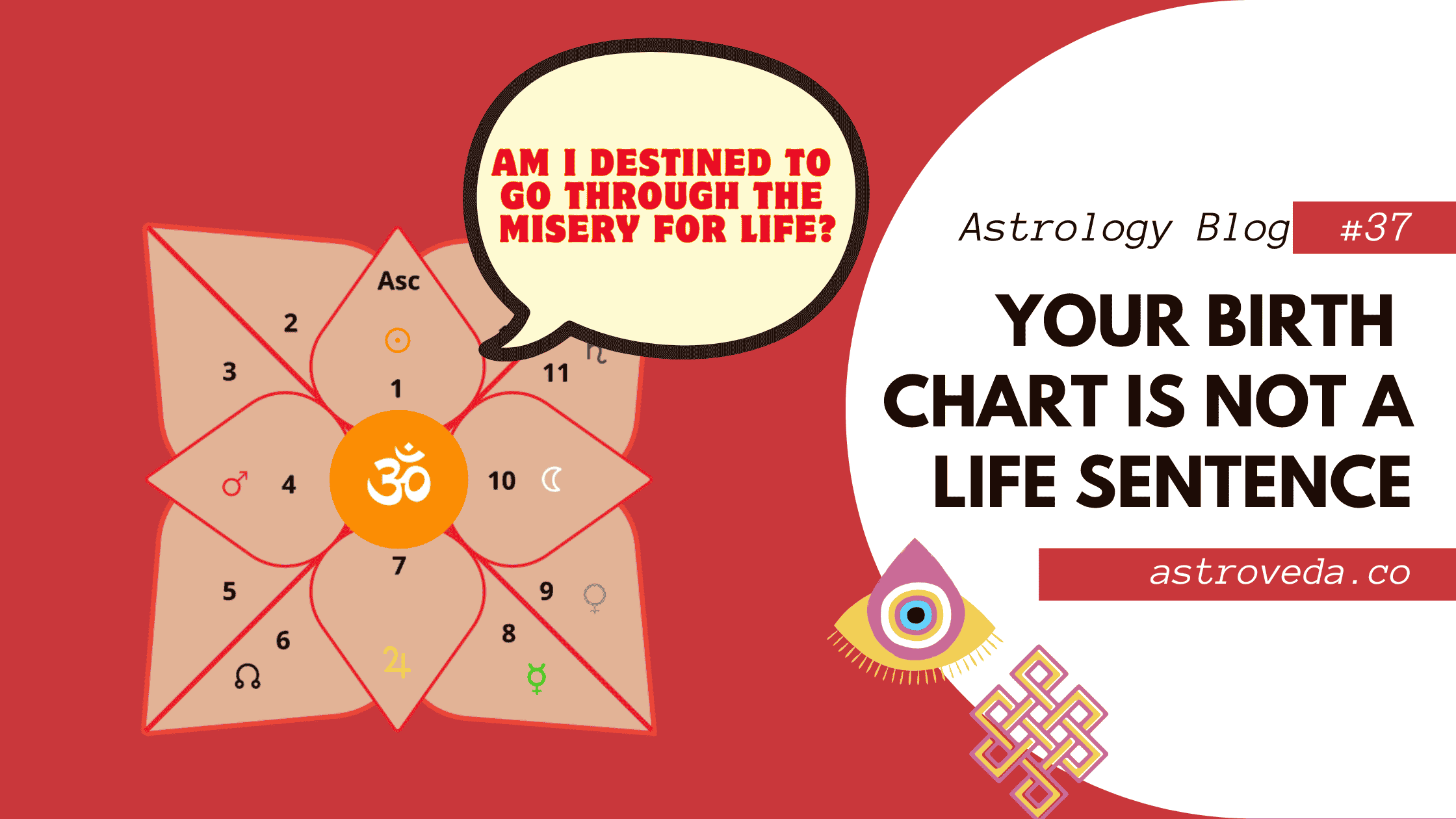
Have you ever opened your astrological birth chart, read a line about a challenging planetary placement, and felt a sudden wave of panic?
Maybe you saw a “weak” Moon, a harsh Saturn aspect, or an afflicted house and thought, “Is this my destiny? Am I just stuck with this forever?”
That reaction is understandable. The language astrology uses can sound clinical and final, like a diagnosis. But it is never meant to function that way. Viewing a birth chart as a rigid blueprint of limitations is not what Vedic Astrology is about.
Your birth chart is not a life sentence. It shows the conditions you begin with, but it never restricts the growth you are yet to experience.
The Birth Chart Describes Potential, Not the Conclusion
A birth chart is created at the moment of birth, so naturally, it cannot change.
But a person does.
The way you understand yourself at 15 may be completely different from the way you understand yourself at 30. The way you respond to conflict, relationships, responsibility, ambition, failure, and uncertainty can change dramatically with experience.
This is where astrological growth becomes important. A planetary placement can describe a particular tendency without determining exactly how that tendency will be expressed.
For example, Saturn indicates delay, responsibility, discipline, restriction, or the need to develop patience. But those aspects can manifest differently at different stages of life. Early in life, Saturn may feel like:
“Why does everything take so long for me?”
Later, the same Saturn may become:
“I know how to build something slowly and make it last.”
The planet hasn’t changed, but the person has.
Soil, Seeds, and the Gardener
Think of your birth chart as the specific plot of land you were given at birth.
- The planets and signs represent the soil quality, the climate, and the seeds planted in your yard.
- You are the gardener.
If your soil is rocky or dry, you don’t throw up your hands and abandon the plot. You clear the stones, add nutrients, water the ground, and learn how to grow hardier, deeply rooted plants.
The chart describes the starting climate. It does not dictate whether you choose to build a greenhouse, cultivate resilient crops, or let the weeds take over.
What “Weak” or “Afflicted” Actually Means
People often obsess over whether a chart is “strong” or “weak.” A planet in its exaltation is celebrated, while a planet in its debilitation is treated like a curse. This view misses the entire point of human growth.
A so-called “strong” chart full of harmonious aspects can sometimes lead to complacency, like a garden blessed with good weather that is never tended to. Conversely, a chart filled with tension and hard aspects often produces the most extraordinary human growth.
A weak/challenging placement isn’t a dead end; it is simply an area of your life that demands your active awareness and evolution. Similarly, a strong/favorable placement is not a smooth sail; active awareness and evolution would still be required.
The entire remedial tradition of gemstones, mantras, chakra balancing, meditation, mudras, etc. exists precisely because astrology has always treated affliction as something to work with, not something to simply endure.
Two Readings, Same Placement?
Take Saturn afflicted in a chart. The reading might say: chronic struggle, bad luck, a hard life. The growth reading can say something different, like “This is an invitation to build stability deliberately, rather than assuming it will show up on its own”. Grounding practices, consistent routines, and patient effort bring visible reward over time.
Similarly, let’s take a neglected Venus as another example. The reading might say: unlucky in love, disconnected, cold. The growth reading can say, “This is an invitation to reconnect deliberately with pleasure, beauty, and connection that doesn’t have to be earned through performance.” Working on the Sacral Chakra, using perfumes, and supporting females sparks the positive Venus energies.
Notice the pattern. In both cases, the “difficult” placement isn’t predicting an outcome. It’s naming an area of life that requires more conscious attention than it might for someone else’s chart. That’s a very different thing from a life sentence.
Example of two celebrities with two different lives.
What “Astrological Growth” Actually Means
Astrological Growth doesn’t mean to change your birth chart. Growth means transforming how you express your chart and your planets, and moving from mechanical reactions to conscious responses.
To achieve growth from your birth chart, a few ideas are worth holding onto here.
A Shift from Tendency to Skill
A placement describes a raw seed, but real-world experience determines how it grows. High potential for leadership, communication, or creativity requires practice, mistakes, and environment to develop into an actual skill.
Using Timings to Activate Different Lessons
Vedic astrology uses dasha periods and transits to highlight specific parts of your chart at different times. Timing doesn’t dictate your actions; rather, it simply determines which life aspects become louder during a specific chapter.
Reframe “Good” and “Bad” Planets
Instead of labeling placements as punishments or rewards, view them as developmental requests. For example, Saturn requests patience, discipline, and healthy boundaries, while Mars requests courage paired with self-restraint.
Remedies as Conscious Practice
Effective remedies aren’t shortcuts to escape your chart out of fear. True remedies involve actively cultivating the maturity of the planet, such as building daily discipline for Saturn or engaging in healthy physical expression for Mars.
More Engagement and Less Blames
Two people with the same “afflicted” Saturn can have very different lives, not because the astrology was wrong, but because one worked with it and one didn’t know there was anything to work with.
All in all, a birth chart analysis is like a weather forecast report that is useful, specific, and worth taking seriously, but not something you’re powerless in front of.
The chart names the terrain. You are the one to walk.
