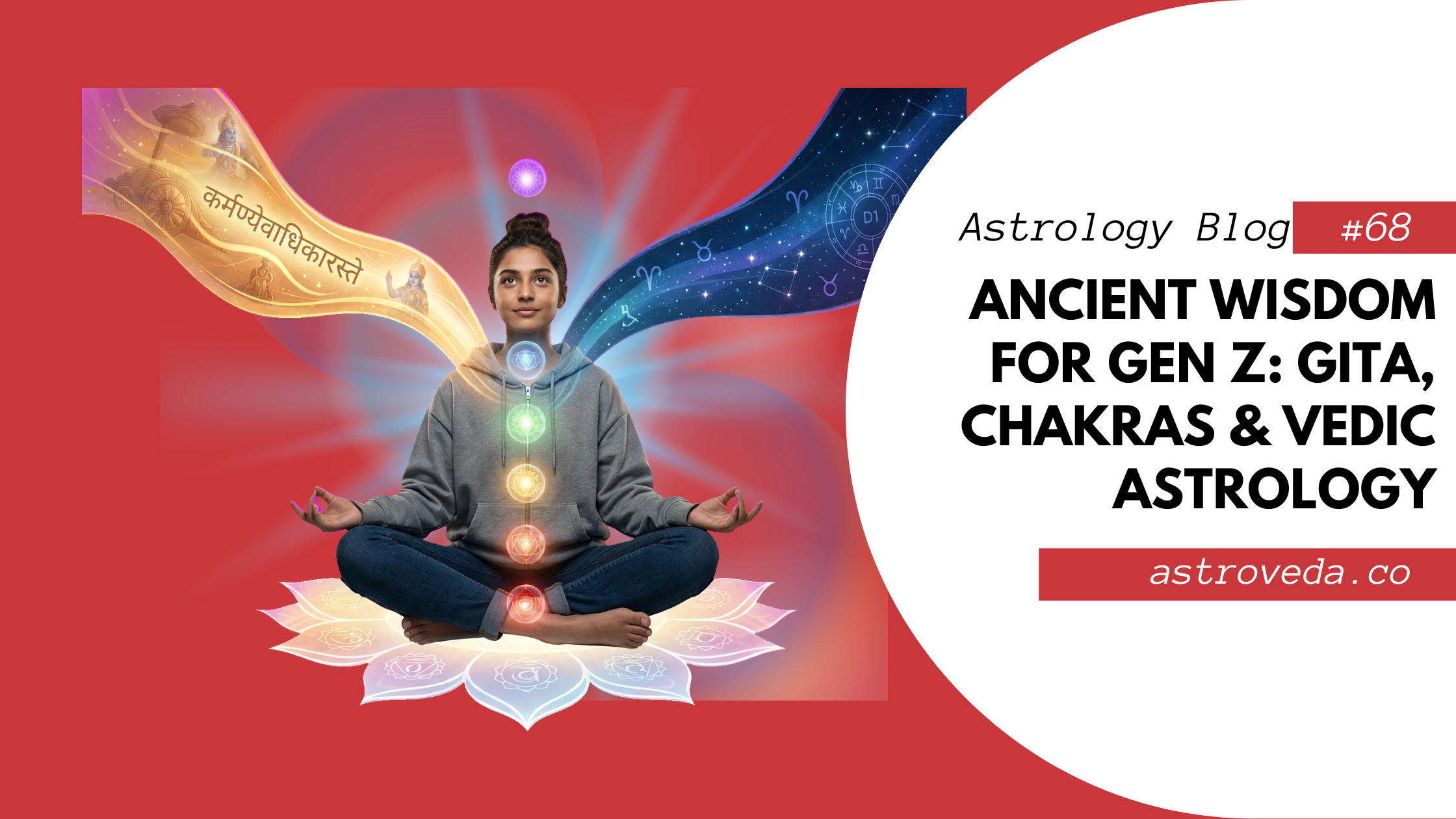
If you are a Gen Z reading this, let me ask you something. You have a thousand followers. Endless information at your fingertips. Opportunities your grandparents could only have dreamed of. And yet some days you still feel completely lost. Why is that?
I have thought about this a lot as an astrologer. And I have come to believe that the biggest challenge for your generation is not a lack of opportunity. It is the struggle to understand your own mind.
So here, I want to share three ancient wisdom traditions that completely changed how I see modern life. And I think they will speak to you too.
The Gen Z Generation
The generation that knows everything about the world but struggles to understand itself!
Picture your morning. Your hand reaches for your phone before your eyes fully open. In two minutes you have seen a stranger’s promotion, a luxury holiday and a perfect couple. Your day has not started, and you already feel behind.
You are the most connected generation ever, and so many of you tell me you feel lonely, overwhelmed and unsure who you are. The pressure to succeed early, earn more, look attractive and become influential turns daily life into a nonstop competition. Even leisure becomes something to display, and happiness starts to feel like something you have to post.
Underneath it all sits a quiet voice.
Am I good enough? What if I fail while everyone else moves ahead?
These questions reach far past career and money. They touch your identity, your belonging, and your sense of meaning.
Even the WHO recognizes anxiety and depression as serious concerns for young people. Screens are one piece of a bigger picture that includes social, economic, and biological factors, and your struggles deserve real attention.
So let’s talk about the education nobody gave you, which is how to understand yourself while you live in this loud world.
What Does The Bhagawad Gita Say
You are not your achievements!
On the battlefield of Kurukshetra, Arjuna froze. Fear, confusion and attachment crushed his confidence, and he had no idea what to do. The setting is ancient and the questions feel brand new. Who am I? What should I chase? How do I handle failure?
Krishna did not tell him to go and win. He taught him how to look at action itself, in Chapter 2, Verse 47.
कर्मण्येवाधिकारस्ते मा फलेषु कदाचन । मा कर्मफलहेतुर्भूर्मा ते सङ्गोऽस्त्वकर्मणि ॥ २.४७ ॥
“You have the right to perform your actions, but you are not entitled to the fruits of those actions. Do not make the results your only motivation, and do not become attached to inaction.”
Our culture treats results as proof of worth. A great grade makes you smart. A bad one makes you doubt everything. A big salary becomes your identity and a layoff feels like a verdict. Likes feel like love and silence feels like rejection.
Krishna offers a freer way. Give your work full effort and sincerity, then loosen your grip on the outcome. That is Karma Yoga. You keep your ambition and you protect your happiness from whatever happens next.
Try asking yourself whether you are better than you were yesterday. That one question changes how you study, work and date.
The Restless Mind
Understanding your mind is more important than controlling your life.
Even Arjuna complained about his mind, in Chapter 6, Verse 34.
चञ्चलं हि मनः कृष्ण प्रमाथि बलवद्दृढम् । तस्याहं निग्रहं मन्ये वायोरिव सुदुष्करम् ॥ ६.३४ ॥
“O Krishna, the mind is restless, turbulent, powerful and stubborn. I think controlling it is as hard as controlling the wind.”
Sound like your last study session? You sit down to focus, and your hand finds your phone. You lie in bed, and your mind replays old conversations and invents tomorrow’s disasters. You promise to stop comparing, and one notification drags you right back.
Krishna answers kindly in the next verse.
अभ्यासेन तु कौन्तेय वैराग्येण च गृह्यते ॥ ६.३५ ॥
“Through consistent practice and detachment, the mind can be trained.”
Abhyasa is steady practice. Vairagya is non-attachment, the skill of watching a thought or feeling without letting it drive. In real life, that means studying with your phone in another room, sitting with uncertainty without asking for reassurance, and noticing a hard feeling without letting it make your next decision.
Still, we are all wired differently. One path to peace cannot fit everyone, and that is where Vedic astrology shines!
Vedic Astrology Maps Your Own Nature
Understanding your individual nature rather than imitating someone else’s life!
Your birth chart treats you as one of a kind. At AstroVeda I use astrology as a tool for self-reflection, beyond predicting love and money.
The most powerful question you can ask is “Why do I react to life this way, and how can I work with my nature?”
Five parts of your chart that help the most
Your Ascendant (Lagna) shows how you walk into life. Some people charge at challenges. Others watch, think, and prepare. Some adapt fast, and some crave stability. Knowing your Lagna and its lord shows you your natural style, so you can grow your own confidence instead of copying someone else’s.
Your Moon shows your emotional world. The Moon rules your mind (Manas), your feelings, and your sense of safety. We study its sign, house, nakshatra and strength to see how you process life and find emotional security. An earth sign Moon often craves routine and practical comfort. An air sign Moon processes life through thoughts and conversation. A water sign Moon feels deeply and longs for closeness. Tough links with Saturn, Rahu, Ketu or Mars can show up as restraint, restlessness, intensity or quick reactions. Your Moon reminds you that people feel things differently, and that is perfectly fine.
Your Mercury shows how you think and learn. Picture three students facing one exam. One learns by chatting, one by reading alone, and one by seeing examples. Mercury’s sign and strength show your style. In a world of notifications and AI, knowing how your mind takes in information is a superpower. Focus, spotting real information from misinformation, and communicating clearly are becoming essential life skills.
Your Saturn shows how you handle pressure and failure. Saturn rules patience, discipline and slow, steady growth. Fear of failure often feels like letting your family down or falling behind your friends. Saturn reminds you that mastery takes repetition and a delay is never a verdict.
Rahu is the thirst for more. If one planet matches the culture of comparison, it is Rahu. It rules intense desire and big, unusual ambition. You hit one goal and a new one appears instantly. Healthy ambition and dependence on outside validation can look alike, so Rahu asks which one is driving you. Rahu also brings innovation and the courage to break limits, so your task is to steer it with awareness before it turns into endless dissatisfaction.
Your chart never labels you lucky or unlucky. It shows your tendencies so you can choose with more awareness.
The Three Gunas
Why do people respond differently to the same world?
Chapter 14 of the Gita describes three qualities of nature.
- Sattva brings clarity, balance and wisdom.
- Rajas brings ambition, desire and restlessness.
- Tamas brings heaviness, confusion and inertia.
We carry all three, in different amounts on different days, but they never measure your worth.
Consider how these qualities can manifest in the lives of young people.
- A Sattvic tendency encourages clarity, thoughtful choices, meaningful relationships and the ability to recognize what truly matters.
- A Rajasic tendency drives ambition, competition and the desire to succeed. It pushes young people to build careers, start businesses and chase big dreams. But when excessive, it can also lead to constant comparison, restlessness and burnout.
- A Tamasic tendency may show up as procrastination, confusion, avoidance and a lack of motivation, making it harder to take constructive action.
What I find most interesting about the Gita’s teaching is that we don’t need to eliminate any of these qualities. We need to become aware of them and learn to balance them.
For Gen Z, this means knowing when ambition is pushing us forward and when it’s exhausting us, when rest is necessary and when avoidance is taking over. The goal is to cultivate more Sattva, channel Rajas wisely and prevent Tamas from holding us back.
The Seven Chakras
Understanding the relationship between security, emotions, identity and consciousness.
Alongside the teachings of the Bhagavad Gita and the insights of Vedic astrology, the traditional yogic understanding of the seven Chakras is also fascinating. Chakras are subtle energy centers associated with different dimensions of human experience. The Sanskrit word Chakra means wheel or circle, and these centers are traditionally understood as part of the subtle body (Sukshma Sharira).
I like looking at the Chakra system as a framework for understanding some of the emotional and personal challenges young people face today. Each Chakra offers a different perspective on our needs, relationships, confidence and search for meaning.
Muladhara Chakra: Security and Stability
A Sattvic foundation begins with feeling grounded and secure. The Root Chakra is traditionally associated with survival, stability, belonging and safety.
For Gen Z, financial uncertainty, career pressure and fear of the future can make it difficult to feel settled. Muladhara symbolism reminds us to build stability through healthy routines, supportive relationships and a strong sense of belonging.
Ask yourself: Am I building a stable foundation for my life, or am I constantly worrying about tomorrow?
Svadhisthana Chakra: Emotions and Relationships
The Sacral Chakra is associated with emotions, creativity, pleasure, desire and connection.
In a world of dating apps, social media and digital relationships, it’s easy to confuse temporary attention with genuine emotional connection. Svadhisthana encourages emotional awareness, healthy boundaries and the ability to experience feelings without letting them control us.
Ask yourself: Do I understand my emotions, or do I allow my desires and other people’s attention to define my self-worth?
Manipura Chakra: Confidence and Personal power
The Solar Plexus Chakra represents willpower, confidence, determination and personal identity.
With constant comparison and pressure to succeed, many young people struggle with self-doubt or feel the need to prove their worth. Manipura symbolism encourages healthy confidence, self-respect and the courage to pursue goals without depending on external approval.
Ask yourself: Am I acting from genuine self-confidence, or am I constantly trying to prove myself?
Anahata Chakra: Love and Compassion
The Heart Chakra is associated with love, forgiveness, compassion and emotional connection.
We live in a world where staying connected is easier than ever, yet loneliness and emotional isolation remain common experiences. Anahata reminds us to nurture genuine relationships, practise compassion and understand that vulnerability is not weakness.
Ask yourself: Am I building meaningful connections, or am I simply seeking attention and validation?
Vishuddha Chakra: Communication and Authentic Expression
The Throat Chakra represents communication, truthfulness and self-expression.
Many young people find it difficult to express what they genuinely feel. Some suppress their emotions to avoid judgment, while others struggle to communicate without reacting impulsively. Vishuddha encourages honest conversations, thoughtful expression and the confidence to speak our truth.
Ask yourself: Am I expressing what I truly feel, or am I hiding behind other people’s expectations?
Ajna Chakra: Awareness and Discernment
The Third Eye Chakra is traditionally associated with intuition, perception, insight and clarity.
Gen Z is constantly exposed to information, opinions, trends and digital influences. But more information doesn’t always mean greater understanding. Ajna symbolism encourages us to question what we consume, recognize our thought patterns and distinguish between temporary impulses and deeper understanding.
Ask yourself: Am I seeing things clearly, or am I allowing comparison, fear and outside opinions to shape my reality?
Sahasrara Chakra: Wisdom and Spiritual Connection
The Crown Chakra is associated with higher consciousness, spiritual awareness and a deeper understanding of existence.
Beyond career goals, money, relationships and recognition, many young people eventually begin asking what gives their lives genuine meaning. Sahasrara invites us to look beyond material achievements and explore our spiritual growth and connection with something greater.
Ask yourself: Beyond everything I want to achieve, what gives my life genuine meaning?
What I love about the Chakra system is how it reminds us that true growth goes beyond material success. It begins with understanding ourselves, nurturing relationships and finding deeper meaning in life.
When The Gita, Astrology And The Chakras Work Together
What I find fascinating is how these three traditions complement one another.
| Tradition | Central question | What it gives you |
| Bhagavad Gita | How should I live? | Wisdom, action and detachment |
| Vedic astrology | What are my individual tendencies? | Self-reflection through planetary symbolism |
| Chakra philosophy | Which part of my experience needs attention? | A contemplative path for personal and spiritual growth |
- The Gita teaches you to act without clinging to results.
- Vedic astrology gives you a symbolic map of your temperament and challenges.
- The chakras help you reflect on everything from security and connection to self-awareness and meaning.
Picture two friends who face the same professional failure. One panics and pulls away from new chances. The other feels sad for a day, then starts looking for another door.
Same situation, different inner world!
The Bhagavad Gita encourages both to rethink their relationship with success and failure. Vedic astrology offers a symbolic lens to explore their individual tendencies, while the Chakra system invites them to reflect on their confidence, emotional responses, and inner stability.
Ultimately, the goal isn’t to find what’s wrong with us. It’s to understand ourselves better and learn how to grow.
A Practical Guide For Gen Z
Five ways to begin understanding yourself better.
I believe ancient wisdom becomes truly valuable when we bring it into our everyday lives. Here are five simple practices inspired by these traditions.
- Observe before you react. Take a few minutes each day to notice your thoughts and emotions. Remember, not every thought needs a reaction.
- Understand your individual nature. Explore your strengths, emotional needs and motivations. You can even use your Vedic birth chart as a tool for self-reflection, rather than treating it as a fixed prediction of your future.
- Practise discipline with kindness. Set realistic goals, build healthy routines and focus on consistent effort. Karma Yoga reminds us to give our best without becoming overly attached to results.
- Nurture meaningful relationships. Communicate openly, establish healthy boundaries and stop measuring your self-worth through social media validation.
- Make time for silence. Try meditation, mindful breathing, yoga or simply taking a break from your phone. Sometimes, stepping away from the noise helps us reconnect with ourselves.
And remember, spiritual practices can support self-reflection, but persistent anxiety, depression, or emotional distress deserve proper professional support.
My Final Message
Don’t spend your entire life becoming someone else!
I think one of the biggest struggles of modern life is that we’re so busy trying to become someone impressive that we forget to understand who we really are. We learn to compete, chase success and build impressive careers, but rarely learn how to handle failure, manage our emotions or find meaning beyond achievements.
The Bhagavad Gita reminds us that our identity goes beyond our accomplishments. Vedic astrology encourages us to explore our individual nature, while the Chakra system invites us to understand our emotional, personal and spiritual needs.
These traditions don’t promise a life without challenges. They encourage us to face those challenges with greater awareness, wisdom and balance.
You can be ambitious and peaceful, successful and compassionate, and pursue material prosperity while nurturing your spiritual growth. You don’t have to compete with everyone, impress everyone or achieve everything at once. Your worth is not defined by your income, appearance, academic results or social media following.
I believe the real journey isn’t about becoming someone the world admires. It’s about understanding yourself well enough to build a life that genuinely feels meaningful to you.
As Krishna teaches us, give your actions your best effort, but don’t let the uncertainty of their results take away your inner peace.
FAQs
Q: Why does Gen Z struggle with anxiety, overthinking and self-doubt?
A: Gen Z faces a unique combination of social media pressure, constant comparison, career uncertainty and information overload. These experiences can contribute to anxiety, overthinking and self-doubt. The Bhagavad Gita offers timeless insights into managing the restless mind, developing emotional balance and focusing on what we can control.
Q: What does the Bhagavad Gita teach about success and failure?
A: The Bhagavad Gita teaches us to focus on sincere effort rather than becoming overly attached to results. In Chapter 2, Verse 47, Krishna explains that we have control over our actions, not their outcomes. This principle, known as Karma Yoga, encourages us to pursue our goals with dedication without allowing success or failure to define our self-worth.
Q: How can Vedic astrology help me understand my personality and emotions?
A: Vedic astrology offers a traditional framework for exploring your temperament, emotional tendencies and motivations through your birth chart. Your Ascendant, Moon, Mercury, Saturn and Rahu each offer different symbolic insights into how you approach life, process emotions, communicate, handle challenges and pursue ambitions.
Q: Which planet in Vedic astrology represents the mind and emotions?
A: The Moon (Chandra) is traditionally associated with the mind (Manas), emotions and mental experiences in Vedic astrology. Its sign, house, nakshatra, strength and planetary influences are considered when interpreting emotional tendencies and the need for security and stability.
Q: What are the three Gunas in the Bhagavad Gita?
A: The three Gunas are Sattva, Rajas and Tamas. Sattva represents clarity and balance, Rajas represents ambition and activity, while Tamas represents inertia and confusion. According to the Bhagavad Gita, these three qualities influence human thoughts, behaviour and tendencies. Understanding them can help us develop greater self-awareness and balance.
Q: What are the seven Chakras and what do they represent?
A: The seven Chakras are traditional subtle energy centers described in yogic philosophy. They are associated with different dimensions of human experience, including security, emotions, confidence, compassion, communication, awareness and spiritual connection. They offer a contemplative framework for exploring personal and spiritual development.
Q: Can balancing Chakras help with emotional well-being?
A: In traditional yogic philosophy, working with the Chakras through meditation, yoga and mindful practices is considered a way to develop greater awareness and inner balance. These practices may support personal reflection and relaxation, but Chakras are not medically established energy centers and should not replace professional mental-health care.
Q: How can I stop comparing myself to others and focus on my own growth?
A: Start by becoming more conscious of what triggers comparison, especially on social media. The Bhagavad Gita’s teaching on Karma Yoga encourages you to focus on your own actions and efforts rather than constantly measuring your progress against someone else’s achievements. Set personal goals and recognize that everyone’s journey unfolds differently.
Q: How can I calm my restless mind according to the Bhagavad Gita?
A: In Chapter 6, Verses 34–35, Arjuna describes the mind as restless and difficult to control. Krishna responds by emphasizing Abhyasa (consistent practice) and Vairagya (non-attachment). In everyday life, these principles can be practised through meditation, mindful breathing, regular routines and learning to observe thoughts without reacting to every one of them.
Q: How can I understand myself better through Vedic astrology, the Bhagavad Gita and Chakras?
A: Each tradition offers a different perspective on self-understanding. The Bhagavad Gita teaches conscious action and detachment from outcomes, Vedic astrology offers symbolic insights into individual tendencies, and the Chakra system encourages reflection on emotional, personal and spiritual needs. Together, they can inspire a more conscious approach to personal growth.
