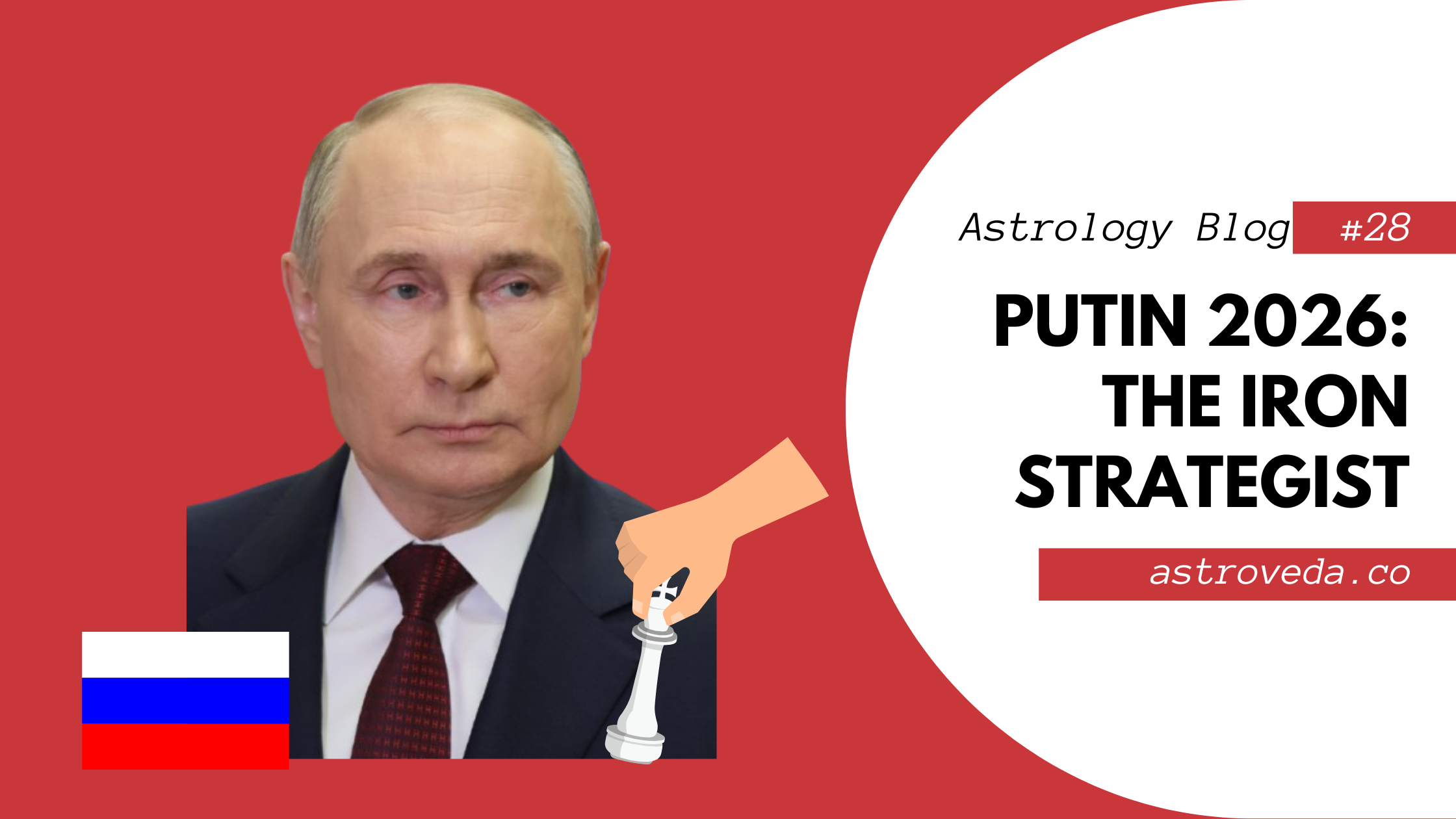
In the realm of global power, few figures project an aura as enigmatic or as intensely controlled as Vladimir Vladimirovich Putin. To look at his Vedic horoscope is to see the blueprint of a leader built for long-term endurance, structural dominance, and the cold geometry of strategic patience. As we move into 2026, the cosmic clock shifts his focus from overt expansion to a period of deep consolidation and karmic recalibration.
The Anatomy of Power: A Natal Analysis
Putin’s chart is anchored by Rahu in the first house in Capricorn, a placement that immediately grants him a commanding, somewhat intimidating presence. Capricorn—the sign of hierarchy and discipline—magnifies a hunger for legacy. This isn’t a leader who seeks flamboyant approval; he is driven by an inner compulsion to master the very structures of authority.
His physical resilience and “psychological edge” are further reinforced by the Lagna lord Saturn conjunct the Sun in Virgo. This combination suggests a leader who values precision above all else—someone who plans with the meticulousness of a grandmaster, viewing the world through a lens of analytical ideology and methodical control.
The Emotional Reservoir and the Shadow Strategis
Perhaps the most revealing strength of his chart is the exalted Moon in the 5th house in Taurus. While his exterior remains iron-clad, this placement suggests a deep inner stability and a powerful attachment to national pride. He does not react impulsively; he processes the world strategically, using nationalistic narratives to connect with the collective sentiment.
In his D10 (Dashamsha) chart, which governs career and public stature, we see the “Shadow Strategist” in full effect:
- Jupiter in the 1st House (Sagittarius): Elevates him to a position of ideological authority, projecting the image of a protector of national philosophy.
- Saturn & Mars in the 2nd House: Indicates a disciplined, often harsh style of speech and economic policy-making.
- Moon conjunct Rahu in the 6th House: A classic “warrior” placement, showing a relentless ability to survive prolonged opposition and dominate rivals.
Global Geopolitics in 2026: The Strategic Pivot
Under the influence of the Mercury Mahadasha, Putin’s 2026 influence becomes more indirect. Power will be exercised through economic leverage, intelligence networks, and “sanctions diplomacy” rather than raw military force.
- United States & Donald Trump: Expect a transactional, mutual suspicion. While ego clashes are likely in mid-2026, the dynamic remains functional and driven by pragmatic bargaining rather than emotional hostility.
- India & PM Narendra Modi: A stable, respectful partnership. The “karmic alignment” between the two nations remains firm, focusing on defense, energy, and multipolar diplomacy.
- China: A relationship of strategic necessity. Putin is increasingly aware of the asymmetrical balance but will maintain the alliance as a bulwark against Western pressure.
- The European Union: Trust remains at a deficit. Expect prolonged stalemates and “sanctions fatigue,” with only selective engagement on energy or security corridors.
2026 Monthly Forecast: The Dasha Timeline
The journey through 2026 for Vladimir Putin is not a straight line, but a carefully choreographed sequence of planetary shifts under the Mercury-Sun Dasha. To understand how this year unfolds, we have to look at it as a three-act play: a quiet beginning, a volatile middle, and a strategic conclusion.
Act I: The Gathering Storm and the Peak of Power
The opening act of 2026 begins in a shroud of strategic silence. During January and February, the influence of Ketu suggests that the Kremlin may retreat into a “back-channel” mode. Public appearances may be sparse as the focus shifts to behind-the-scenes negotiations and internal recalibrations. However, this quietude is short-lived. By March, the curtain rises on a display of peak authority. Under a double Sun influence, Putin is likely to project a renewed sense of sovereignty, making bold diplomatic statements that demand the world’s attention. This energy carries into April, but the tone shifts from cold command to national unity. This is a month for the “emotional pulse” of Russia, where the focus is on domestic resonance and reinforcing the bond between the leader and the collective identity.
Act II: Volatility and the Fog of War
As the year moves into the late spring and early summer, the atmosphere thickens with tension. May stands out as the most volatile month on the calendar. With Mars activating the Sun, the rhetoric sharpens, and the potential for tactical escalations or military signaling reaches a high-water mark. It is a period of “heat” where the strategist’s patience is tested by the impulse for action. This volatility doesn’t disappear in June; it simply changes form. Under Rahu’s influence, the landscape becomes one of geopolitical fog. Expect a surge in propaganda, intelligence-led maneuvers, and uncertainty. It is a month where nothing is quite as it seems, and the “shadow strategist” is at his most active, navigating a hall of mirrors in global diplomacy.
Act III: The Great Stabilization and Recalibration
The turning point of the year arrives in high summer. July and August offer the most significant window for stabilization seen in years. Under the stabilizing gaze of Jupiter, the “Vishwa Guru” or mediator energy comes to the forefront. This is the time for treaties, frameworks, and genuine mediation. If the conflicts of the past are to find a face-saving resolution, it will likely be drafted during these months.
“2026 is a year where the weight of history is finally met with the discipline of reality.”
The gravity of the year hits in September, a month defined by karmic accountability. Under Saturn’s watchful eye, the focus shifts from the excitement of the negotiation table to the hard, disciplined work of formalizing and implementing sustainable agreements. Finally, as the year closes from October through December, the energy settles into a quiet, calculated focus on restoration. The narrative shifts toward the economy and the rebuilding of internal systems, ending 2026 not on a note of conquest, but on one of controlled, strategic balance.
The Conflict in Ukraine: A Transition to Peace?
On the Russia–Ukraine front, 2026 appears to be a turning point from active confrontation to a “managed conflict.” The July–August Jupiter influence strongly supports mediated agreements and face-saving frameworks. While a clean resolution remains elusive, the planetary patterns suggest a significant reduction in intensity, with September 2026 being a decisive window for formalizing sustainable boundaries.
“2026 is a year of consolidation rather than conquest. Putin’s role remains influential, but increasingly subtle—navigating the pressure of the West and the reliance on the East with unyielding strategic patience.”
Common Questions: Putin’s 2026 Astrology
Q: Will the Russia-Ukraine war end in 2026?
A: Astrology points toward a “frozen conflict” or a significant de-escalation rather than a definitive “victory.” The mid-year Jupiter transit favors negotiations, while the September Saturn influence suggests a formal, albeit difficult, implementation of agreements.
Q: Is Putin’s leadership under threat internally?
A: While June and September 2026 bring “karmic accountability” and pressure, the D10 chart (Moon-Rahu in the 6th) suggests he is exceptionally skilled at surviving opposition. He is more likely to restructure his administration than to lose control of it.
Q: How will the Russian economy fare?
A: Continued pressure is certain, but not collapse. The chart shows a successful “economic recalibration,” finding stability through Asian energy partnerships and alternative payment systems.